

Is the Way You’re Earthing Helping or Harming You?

I could probably make a small fortune promoting earthing products.
Here’s why I don’t, why productive earthing is often inconvenient, and where quieter ground may still be found.
The Earth Beneath Our Feet is Polluted
Since we’ve been using the earth as an electrical dumping ground for generations, I have to ask:
Is the way in which you are earthing today both helping and harming you?
I ask this because I believe earthing can do either, or both at the same time.
And I know—earthing is often presented as something universally beneficial.
Earth wherever you like, however you like. Reduce inflammation. Sleep better. Heal.
And in the right environment, I believe there are many benefits.
But the Earth itself is no longer electrically quiet, as it once was.
By “electrically quiet,” I mean environments with no electrical noise, no AC current flow through the earth, no radiofrequency exposure, and no nearby energized infrastructure.
Most people today have never experienced prolonged residence within a truly electrically quiet environment and therefore possess little frame of reference for comparison.
Until 1889, direct contact with the ground meant connection to a stable natural electrical environment. Man-made electrical noise did not yet exist. The relationship between the body and the earth occurred within an environment free from modern electrical interference.
Increasingly, this is no longer true.
Modern electrical infrastructure is altering the electrical environment beneath our feet. In many populated areas, the earth now carries not only its natural electrical potential, but also man-made alternating current, harmonics, switching transients, and other forms of electrical noise introduced by modern civilization.
And that changes the equation entirely.
Because a beneficial connection that also contains potentially harmful elements may no longer remain beneficial overall in practice.
Even worse, the body may perceive relief even while the overall exposure remains fundamentally unfavorable.
This is the part of the earthing conversation I rarely hear discussed.
Not whether earthing “works.”
But whether the environment in which it occurs now contains a mixture of both helpful and potentially harmful exposures.
In other words:
What if the focus is not earthing itself, but how and where it’s done?
That question can profoundly change the way we think about earthing, indoor grounding systems, and the modern electrical environment itself.
And it has led me to believe that when it comes to earthing, the farther one moves from energized infrastructure of all types, the better.
What is Earthing?
Earthing — the simple act of direct feet-to-ground contact with the earth — is natural. The human body was created for our planet’s electrical environment, standing between the earth’s negative potential and the positive potential of the ionosphere above. Across that space exists a natural DC vertically oriented electric field, part of the quiet electrical backdrop in which life was created.
In a pristine environment, touching the ground reconnects the body with that electrical reference. Many people report a sense of calm, faster healing or recovery, improved sleep, or reduced inflammation from direct contact with the earth. In such places, earthing can indeed be restorative.
Current Flow and Exposure to Electrical Noise
The modern electrical grid changed something fundamental.
In North America and many other regions, electric power distribution is designed so that a significant portion of return current flows not only through conductors, but through the earth itself.
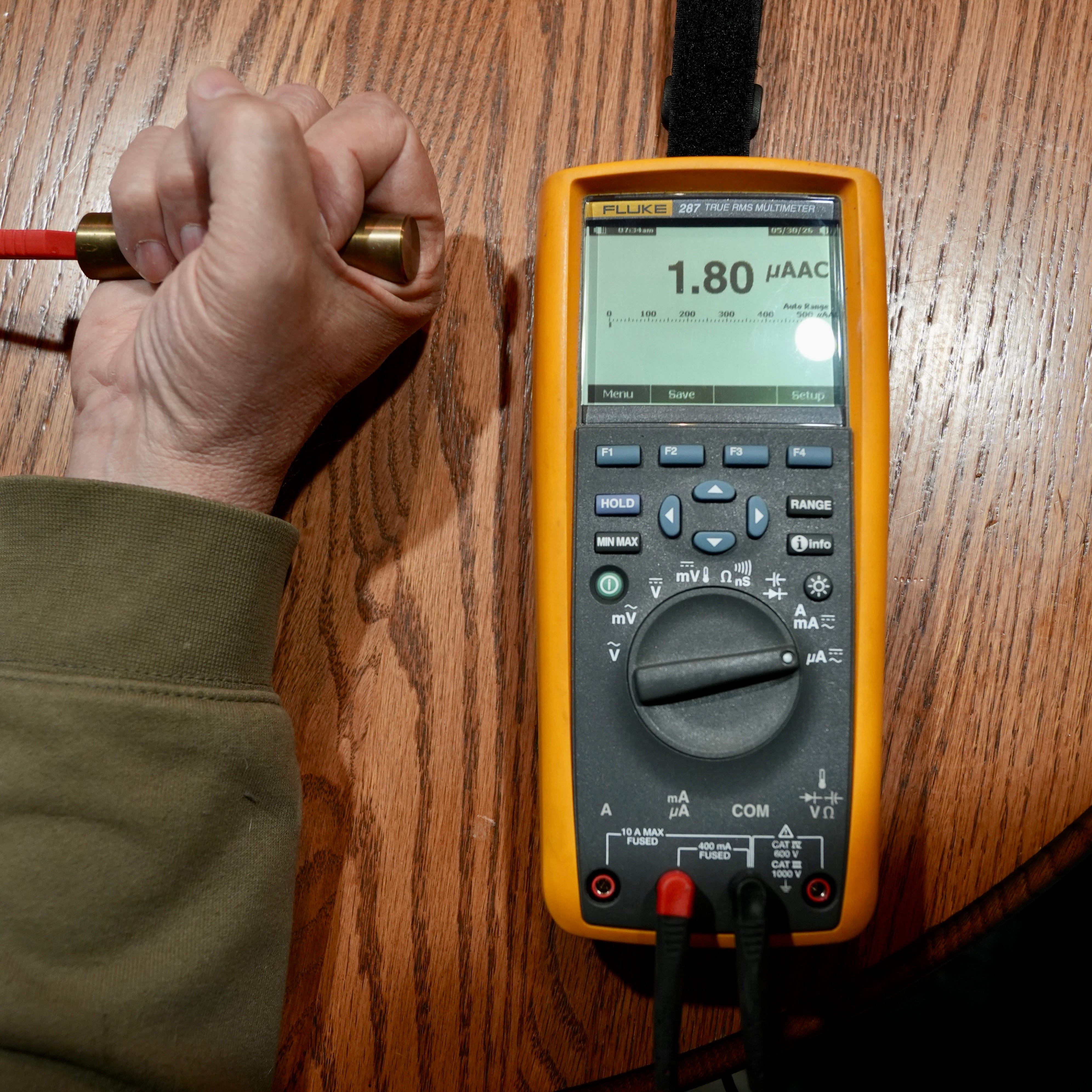
AC current flowing through my body
As a result, the ground near electrically developed areas now carries man-made alternating currents, harmonics, switching transients, and other higher-frequency artifacts produced by modern electronics and switching power supplies.
In other words, while the ground beneath our feet still retains its negative DC charge, it is no longer always the calm electrical reference it once was. Increasingly, it contains forms of electrical pollution—electrical conditions historically absent from the natural environment.
Signal and Noise
This is where a useful concept comes into play: signal-to-noise ratio.
The “signal” is the earth’s natural electrical potential—a vital part of the created environment.
The “noise” is the electrical activity introduced by modern infrastructure: power-frequency currents, harmonics, switching transients, and other electrical activity now moving through the same earth.
Research in this area remains sparse. But I believe that where the natural signal remains dominant, earthing may still provide benefit. Where electrical noise is too high, earthing may become unproductive at best—and potentially harmful at worst.
Among my clients and friends—particularly those whose bodies have not become habituated to synthetic field exposures—I repeatedly observe the same pattern. In electrically quiet natural settings, earthing often feels restorative. In electrically noisy environments the same practice may feel uncomfortable, agitating, or even draining.
This may reflect either or both: tiny current flow through the body and the introduction of electrical noise into already delicate biological systems.
Even extremely small electrical currents can influence biology. In electrophysiology it is well understood that microamp-level currents are capable of affecting membrane voltage, ion transport, and cellular signaling. These effects may be subtle and not immediately perceptible, but they occur within the same electrochemical systems that regulate cellular stability and metabolism.
When a person stands barefoot on ground carrying alternating current, two points of contact—the feet—may allow small currents to pass through tissue toward other electrical references within the environment. The currents involved may be tiny, but biology operates on tiny electrical gradients.
Under those circumstances, earthing may no longer represent connection to a stable natural reference, but participation in an electrically active return network.
The Importance of a Quiet Electrical Reference
Throughout this essay, I’ve discussed two related concerns: potential current flow within the body and exposure to electrical noise.
But exposure to electrical noise stands alone as its own concern.
The body’s bioelectrical systems do not operate in isolation. They exist within, and may continuously reference, the electrical environment around them.
For most of human history, that reference was quiet and stable.
Today, in many electrically developed environments, it is no longer quiet or stable at all.
Instead, the earth itself now carries electrical noise imposed upon what was once a comparatively calm natural electrical reference.
Even if meaningful current flow within the body is absent, the body’s own bioelectrical systems may still function less coherently when continuously referenced to an electrically noisy environment.
An analogy from electronics may help illustrate the concept.
In sensitive analog circuits, a noisy ground reference can degrade signal integrity even when the circuit itself remains operational. The system still “works,” but precision, stability, and coherence begin to deteriorate.
The same may potentially be true biologically.
The body may continue functioning while subtle degradation occurs within systems dependent upon stable electrical relationships.
This remains speculative. Research specifically exploring these questions is sparse—perhaps unsurprising given the difficulty of studying subtle long-term biological effects and the limited financial incentive to fund research that may challenge modern electrically dependent infrastructure and technologies.
But whatever the precise mechanism ultimately proves to be, I believe it is reasonable to assume that chronic exposure to synthetic electrical noise is not biologically neutral.
And that may help explain why some individuals report feeling calmer, clearer, or more physiologically stable in electrically quiet environments even when they cannot consciously identify a specific exposure source.
It may also help explain why habituation to electrically noisy environments is not necessarily evidence of safety. Loss of perceptual contrast does not guarantee preservation of biological stability or coherence.
If this line of thinking proves even partially correct, then the quality of the electrical reference beneath our feet may matter far more than most people realize.
This is another reason why the signal-to-noise ratio matters.
The body may perceive relief even while the overall signal-to-noise ratio remains unfavorable.
Unfortunately, the places where people most commonly attempt earthing are often among the worst environments for it: land served by electrical infrastructure—and worse still, within electrified homes.
Reducing Inflammation and Causing Harm
Is it possible to experience a short-term perceived benefit—reduced inflammation, for example—while simultaneously participating in a potentially harmful tradeoff?
Of course.
Consider Tylenol® (acetaminophen). It is widely used because it can reduce pain and inflammation. Yet it is also recognized as one of the leading causes of acute liver failure.
I believe it’s important to recognize such tradeoff exist.
The same may be true of earthing in less than pristine environments. A person may experience some benefit from connection to the earth’s natural electrical signal while simultaneously increasing exposure to electrical noise and the possibility of current flow within the body.
In other words, the body may perceive relief even while the overall signal-to-noise ratio remains unfavorable.
For that reason, I do not encourage indoor earthing systems. Direct contact with the ground can still be valuable—but only when the ground itself is electrically quiet.
I often learn the most through my own mistakes.
Years ago, I experimented with one of these indoor earthing systems myself—thinking it would be helpful. What followed over several sessions was the onset of what I perceived to be cardiac dysrhythmia—something sufficiently unusual and concerning that I discontinued its use. The symptoms resolved after stopping.
Experiences like this are valuable because unexpected outcomes often challenge assumptions we previously held.
I cannot prove causation. But the experience profoundly changed my view of indoor earthing.
More importantly, it left me with another concern: that many people no longer perceive such warnings at all.
Finding Better Places
The places most likely to preserve the original relationship between the body and the earth are often the same places modern civilization considers inconvenient.
The farther you move from energized infrastructure, the lower the environmental electrical noise often becomes.
One of the hidden signatures of healthier ground may simply be the absence of energized infrastructure.
Remote landscapes. Wild land. Distant seashores. No signs of civilization.
The seashore may be especially interesting.
Salt water is an excellent conductor, yet the ocean itself is electrically enormous and generally not part of the utility return-current network associated with inland electrical infrastructure. A wet sand beach at low tide—particularly one distant from dense coastal development—may therefore represent one of the better remaining earthing environments available today: excellent conductivity coupled to a massive and comparatively electrically quiet body.
These are not guarantees.
They are simply potentially better places to begin searching.
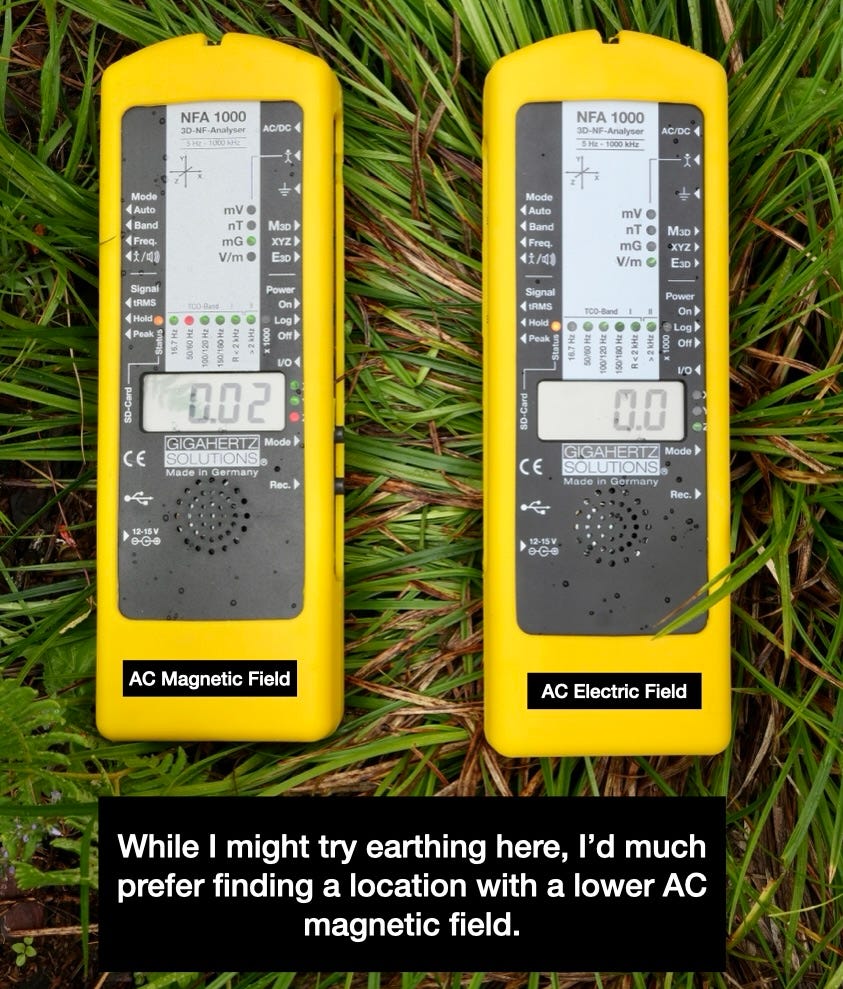
Photo by author
One clue that may help identify such environments is ambient 3-axis AC magnetic-field intensity. Levels above 0.00 mG, measured on an accurate meter, imply the presence of energized infrastructure and associated current flow affecting the environment. Levels approaching 0.00 mG may indicate that these influences are minimal.
Where I live—sparsely populated and distant from heavy infrastructure—ambient 3-axis magnetic fields often hover around 0.02 milligauss on a meter with ±1 dB accuracy. In more remote locations I have occasionally measured 0.00 mG.
AC electric fields—measured three-axis, which is very important—matter as well. Because AC electric fields readily couple with the human body, zero EF on an accurate meter is critical if one hopes to minimize the possibility of current flow within the body.
Taken together, these conditions may help identify environments where the natural electrical signal remains dominant and electrical noise remains comparatively low.
A good 3-axis AC magnetic-field meter and 3-axis AC electric-field meter, combined with simple observation—looking for places truly distant from electrical and wireless infrastructure—can provide useful guidance for those seeking cleaner environments for earthing.
For more advanced users, frequency-domain analysis using an oscilloscope may provide additional insight into the electrical characteristics of a location and the presence of higher-frequency electrical activity.
But even then, no guarantees exist.
We are attempting to navigate an increasingly electrically altered world.
One place I would not look, however, is indoors.
Don’t Earth Indoors
For many years, commercial products have appeared promoting earthing inside buildings. These typically involve conductive pads, sheets, straps, or pillowcases connected either to the grounding conductor of a wall outlet or to a stake driven into the soil outside.
I’m concerned that this practice may carry significant risks.
Indoor grounding products often connect a person into the electrical grounding and bonding system—not merely pristine earth.
With electrical service to most buildings, the equipment grounding conductor is bonded to the neutral conductor and therefore electrically associated with the broader return-current network leading back toward the local substation.
As a result, grounding systems within modern buildings may contain power-frequency electrical activity and other forms of electrical noise produced by modern electronics and the electrical grid itself.
Connecting the body directly to that system effectively links a person to the building’s electrical environment.
Outdoor grounding stakes do not necessarily solve the problem. Utility return currents may still flow through the surrounding soil itself, and the wire connecting an outdoor stake to an indoor grounding pad may also couple with surrounding electrical activity across a broad range of frequencies.
In other words, what appears to be a simple connection to the earth may, in practice, become a conduit for electrical noise both through direct connection and through the surrounding environment.
Some studies and anecdotal reports do suggest benefits from these indoor grounding systems, such as improved sleep or reduced inflammation. One possible explanation again returns to signal-to-noise ratio. Even within electrically noisy environments, patches of natural potential still exist, and sometimes the body may respond to that signal despite surrounding interference.
But, like the Tylenol example, reduction of one symptom may come at an unexpected cost.
If You Must Earth Indoors
Additionally, I do not encourage anyone to explore indoor earthing systems for one reason above all the others already discussed:
In working with those reversing electromagnetic poisoning—individuals who are genuinely gaining resilience and reducing (not eliminating) sensitivity—I have never known a single one of them to mention indoor earthing.
Not one.
Earthing, yes—indoors, never.
That observation does not constitute scientific proof. But I don’t consider that absence insignificant.
If indoor earthing were fundamentally restorative within modern electrically active environments, I would expect at least some of the people making the greatest recoveries to be using it successfully as part of that process.
Instead, I observe the opposite pattern.
The individuals making the greatest progress are typically reducing electrical noise wherever possible—especially within the home environment—not intentionally increasing conductive interaction with it.
All this having been said, if you still wish to experiment with indoor earthing, there may be a way to reduce one of the most important concerns: potential current flow within the body.
Andrew McAfee invented a device called the NCB (Nuisance Current Blocker). I have no financial interest in the NCB, nor am I making any representation regarding its effectiveness or safety. I should also say that I’m a fan of Andrew’s work generally and believe he has made a number of important contributions to the art and science of synthetic field avoidance.
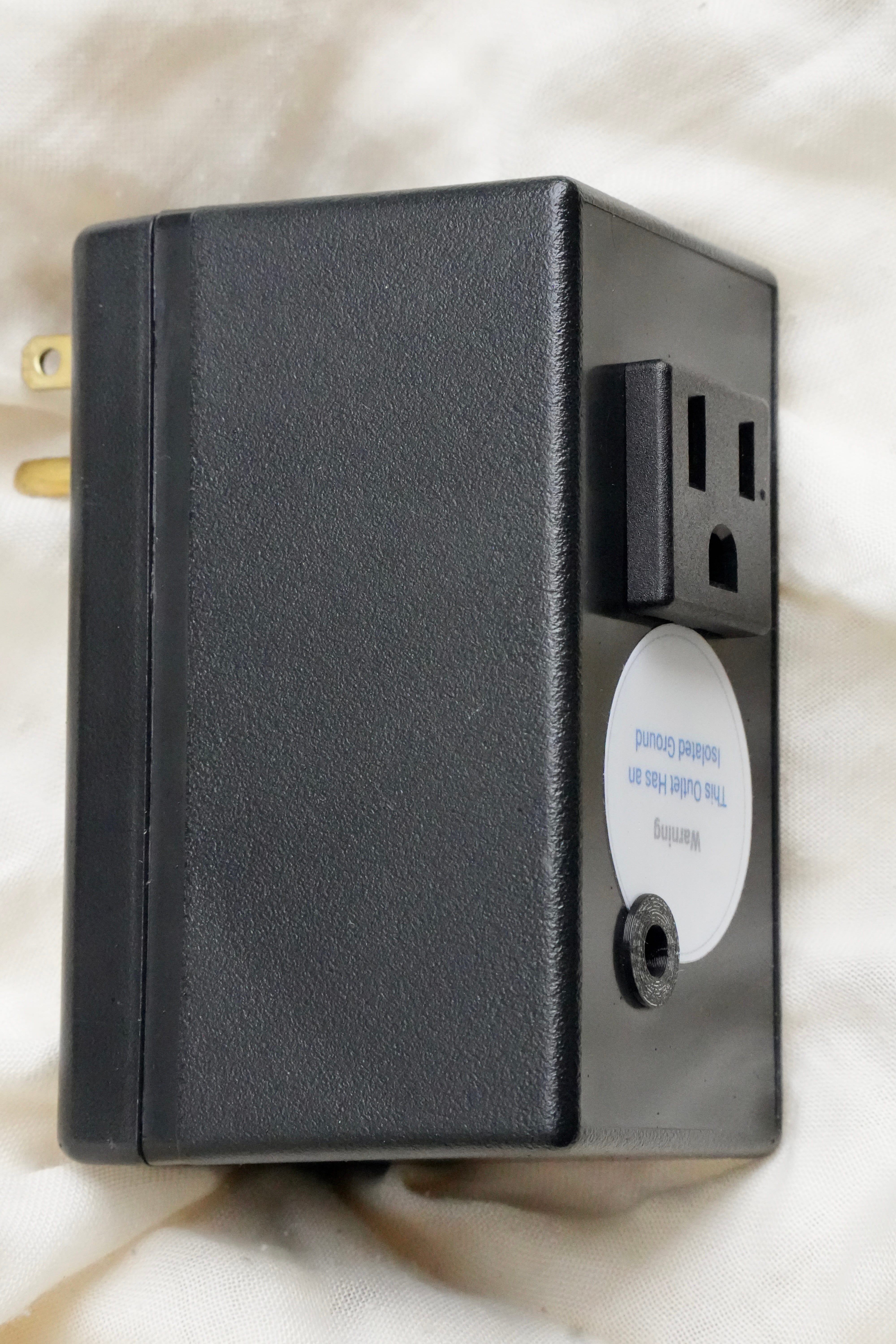
Photo by author
The NCB’s associated patent application states:
“The Nuisance Current Blocker (NCB) is a unique protective device that utilizes resistors, gas discharge tube arrestors and choke/inductors to block low level current on equipment grounding conductors while maintaining an effective ground fault path to quickly activate overcurrent protective devices.”
If you are determined to explore indoor earthing, you may wish to consider reducing the possibility of current flow through the body.
And perhaps one final thought.
Time-Based Source Removal
In my work, I often speak about the three primary ways to reduce exposure: remove the source, increase distance, or reduce time.
If one chooses to experiment with indoor earthing despite the concerns discussed throughout this essay, it may be worth considering whether a brief five-minute exposure is fundamentally different from maintaining conductive contact with an electrically active environment continuously throughout an entire night.
Even when removal of the source is not possible, periodic reduction in exposure time may still meaningfully alter the overall signal-to-noise ratio experienced by the body.
And those whose bodies still clearly warn them of synthetic field exposures may possess an important advantage in this regard. Discomfort, agitation, insomnia, cardiac awareness, or other unusual responses may serve as early signals that something is not well tolerated.
But if your body no longer warns you clearly—if habituation has dulled perceptual contrast—it may be wise to proceed with even greater caution.
Groovy Indoor Earthing Products?
When I was young enough to begin evaluating the opinions of others, my father gave me a simple piece of advice: “Consider the source.”
That principle still serves me well.
There is no money in telling someone to walk barefoot on electrically quiet land far removed from infrastructure. No product to manufacture. No affiliate commission to earn. No recurring revenue stream.
Indoor earthing products are different.
Manufacturers profit by selling conductive mats, sheets, pillowcases, straps, and grounding accessories. Content creators may then promote those same products through affiliate relationships, receiving a percentage of each sale generated through their links or recommendations.
None of this necessarily implies bad intent. Many people promoting these systems may sincerely believe they are helping others.
But financial incentives still matter.
And convenience matters too.
One of the recurring themes in my work is that increased convenience often comes with increased synthetic field exposure. Indoor earthing offers the appealing promise of remaining inside a modern electrically active environment while still obtaining the perceived benefits of connection to the earth in a pristine place.
But this is precisely where I believe the problem lies.
Whether through the ground lug of an indoor electrical receptacle or a stake driven into the soil near the home, indoor grounding systems may connect a person not merely to pristine earth, but to the broader electrical grounding and bonding network of the modern electrical grid itself—creating both the possibility of current flow within the body as well as direct exposure to electrical noise.
In signal-to-noise terms, the body may gain some benefit from the earth’s natural electrical signal while simultaneously suffering harm from either—or both—potential current flow within the body and exposure to an electrically noisy environment.
I would encourage anyone evaluating indoor earthing claims to carefully consider both the exposures involved and the incentives surrounding what is being promoted.
Conclusion
What I’m offering here is not settled science, but a framework born from years of observation, personal experience, measurement, and work with people attempting to recover from synthetic field exposure.
I hope it’s helpful.
The modern world increasingly conditions us to assume that what is natural remains beneficial regardless of context. I no longer believe that assumption is safe.
In antiquity, the relationship between the body and the earth was never a wellness trend, a product category, or a biohack. It was part of the created order itself—an environment designed for life.
But degradation of environments matters.
A healthy signal immersed in sufficient noise may no longer remain beneficial in practice. And in many places today, the earth beneath our feet is no longer electrically quiet.
That reality changes the discussion entirely.
The question is no longer simply whether earthing “works.” The question is whether the environment in which it occurs still preserves a favorable signal-to-noise ratio.
In truly quiet places—remote landscapes, wild land, distant seashores—the ancient relationship between the body and the earth may still remain largely intact. In electrically developed environments, however, direct contact with the ground may also mean participation in a complex electrical system increasingly foreign to the natural world.
That distinction matters.
Because modern civilization increasingly encourages us to assume that natural relationships remain safe regardless of environmental change. Earthing may simply be one more example showing that assumption is no longer always true.
And perhaps that is the deeper lesson here.
The problem is not the earth.
The problem is that we are increasingly using it as a dumping ground for synthetic electrical exposures foreign to the natural world—electrical noise impressed upon the environment itself, not merely passing through it.
And as with so many other dimensions of the electromagnetic realm, we are quietly creating more and more places that are, from a biological perspective—and in accordance with individual awareness—increasingly uninhabitable.
Still, I do not believe all places are equal.
There remain quieter places. Places where the noise is low enough that the original relationship between the body and the earth may still persist much as it once did.
Those places are rarely the most convenient.
But perhaps that has always been true of the narrow way.