

The Only Two Metrics That Matter in Electromagnetic Recovery

It’s simple: if your symptoms appear sooner and are more intense, and your recovery takes longer, you’re on the wrong path. If your symptoms take longer to appear, are less intense, and your recovery is faster, you’re headed in the right direction. If these trends aren’t moving in the right direction, you must make changes.
When I was at my worst in suffering from electromagnetic poisoning (others call it EHS), I began a journey of effective avoidance—measurably reducing daily exposures to synthetic fields. It proved to be the right direction. My health, vitality, and cognitive abilities improved quickly and dramatically in ways I hadn’t imagined possible.
Over time, I realized that, for me, meaningful recovery could be summed up with just two metrics:
Decreasing sensitivity – symptoms take longer to appear and are less intense during acute exposure.
Increasing resilience – recovery happens more quickly after acute exposure.
In my own experience, tracking these two metrics doesn’t require a laboratory. I haven’t needed any kind of portable dosimeter to calculate weighted exposure to every combination of phenomena, frequencies, and modulation schemes in daily life—if such a thing even exists. No blood tests required. I’m simply sharing personal observations, not offering medical or scientific advice—just passing along something I’ve learned in the hope it may be useful to you.
Here’s how I track each metric in daily life:
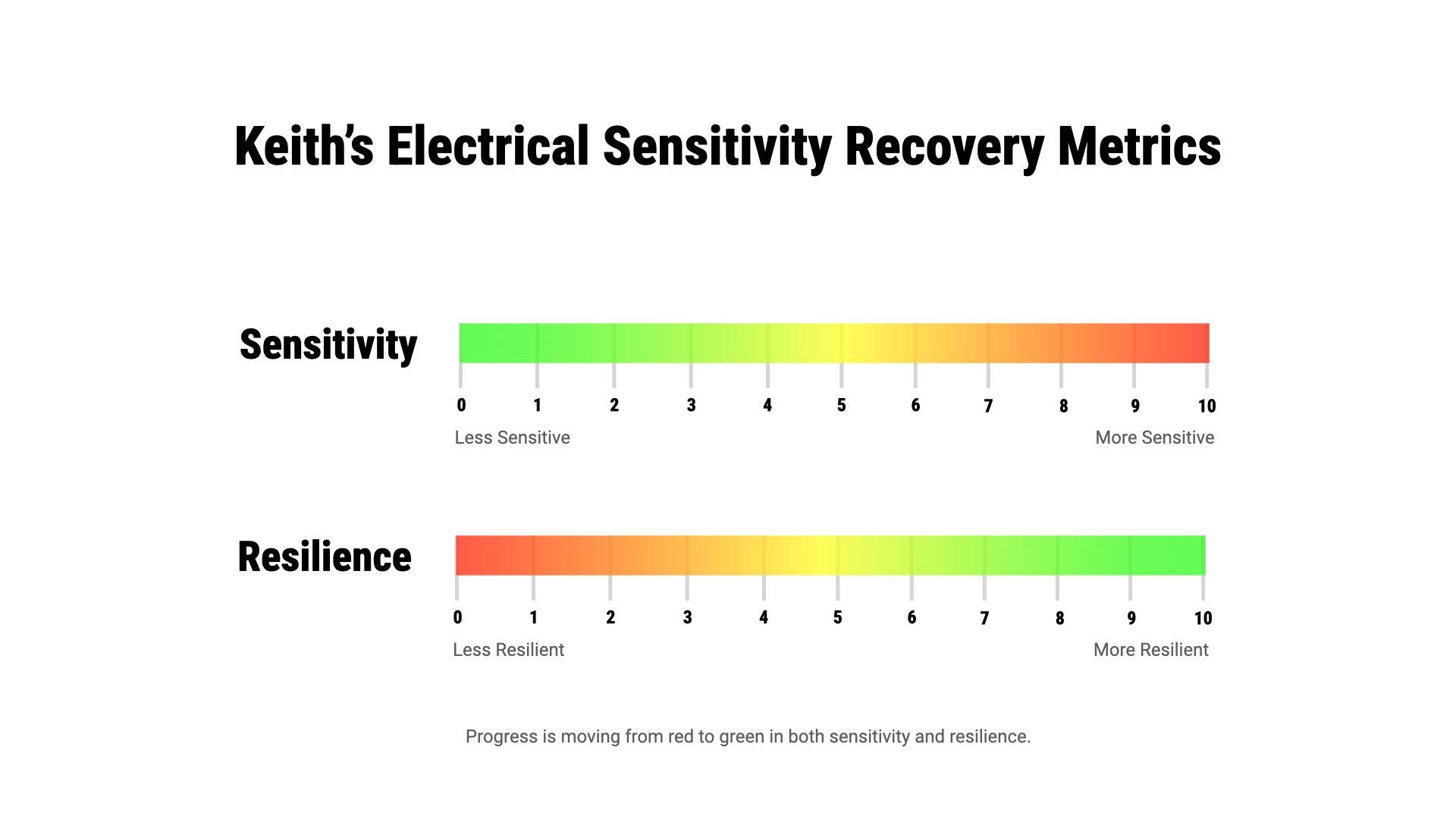
Sensitivity
I pay attention to my body’s feedback in real-world situations. For example, I sometimes take my wife to lunch in town. All restaurants come with a mandatory toxic side order of WiFi “service,” and most patrons bring their own synthetic field emitters. I don’t need exact readings—I simply notice how long it takes before my brain starts to short-circuit, my heart misbehaves, or my mood shifts from joyful and loving to irritable and fussy. That timing tells me all I need to know about my current sensitivity.
To account for variations in daily exposure—such as more or fewer active cell phones nearby—I’ll often sit at the same table and compare results over multiple visits to the same restaurant. In 2018, there wasn’t a restaurant in my town where I didn’t get sick within five minutes. I could force myself to endure up to twenty minutes, but I was always much worse for the wear afterward. By contrast, for several years now I can comfortably enjoy lunch with my wife in any restaurant in town for over an hour. That’s a clear, measurable decrease in sensitivity.
Resilience
When I think about resilience, I think about recovery time—how long it takes to bounce back from a significant exposure. In 2018, it could take more than a week to recover, even sequestered in a remote house with the power off and an RF background of less than 0.4 μW/m².
Today I recover within minutes, hours, or at most overnight—even after intense exposures in client homes, such as multiple routers running alongside cordless phone systems and smart meters. I think of this metric the same way I think about recovering from a cold or flu: you got sick, now how long until you’re well again?
The Takeaway
In my own experience, these two metrics—sensitivity and resilience—are practical, observable, and uniquely personal. Tracking them hasn’t required specialized instruments, only honesty, consistency, and a willingness to listen to my own body. I’ve often noticed changes over the course of months rather than years. When both have moved in the right direction for me, it has felt like more than survival—it has felt like recovery.
If you notice these metrics moving in the wrong direction, it may be worth making changes that fit your own situation. I’m not offering medical or scientific advice—just sharing what has worked for me and others I’ve worked with. If you’d like to explore these ideas further, you’re welcome to schedule a consult—I’m happy to share my observations in the hope they may be useful.
Thank you, Mr. Cutter, for summarizing your experience in just two words: Sensitivity and Resilience. Those should be adequate for anyone motivated enough to improve his/her lot.
While diabetics might be able to track blood sugar levels with a device, then see the impact of decisions and change those and track again, EMF *effects* are not so easily quantifiable. Thank you for this. Succinct. This is such a practical and personal way to describe the process.