


Those choosing a technology should bear its uncertainties as nearly as possible.
That principle is rarely considered in discussions of wireless communication. A person may decide that the convenience of Wi‑Fi is worth whatever uncertainties accompany it. But the radiation produced by that decision does not remain with the person who made it. It passes through walls, floors, ceilings, windows, and property lines, creating forced exposures for neighbors, coworkers, passersby, and others who were never asked whether they consented.
Li‑Fi may offer a fundamentally different arrangement.
Its greatest promise isn’t that it eliminates synthetic exposure for its users, but that it can contain that exposure far more effectively within the space where it is chosen, rather than imposing forced exposures upon everyone nearby.
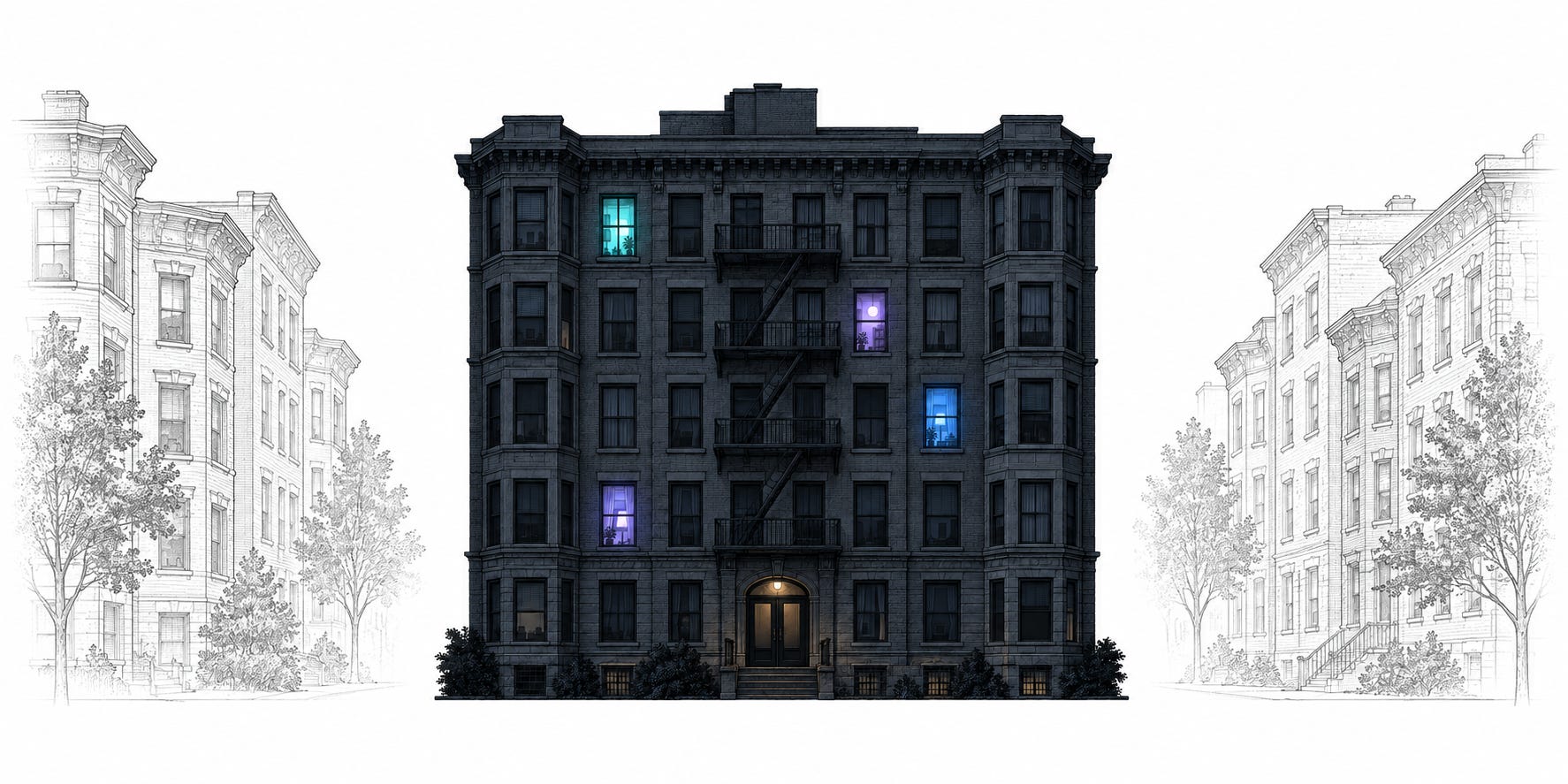
Relocating wireless radiation within the electromagnetic spectrum
The electromagnetic spectrum is vast. Radio waves, microwaves, infrared, visible light, ultraviolet, X-rays, and gamma rays all occupy portions of it. The narrow band we perceive as visible light lies between ultraviolet and infrared, while infrared itself extends from near-infrared through mid- and far-infrared.
Li‑Fi doesn’t remove communication from the electromagnetic spectrum; it relocates it within that spectrum.
Wi‑Fi transmits information using radiofrequency radiation. Li‑Fi commonly transmits information using visible light or near-infrared. Calling the carrier “light” does not place it outside the electromagnetic spectrum, nor does it answer every biological question associated with its use. What changes is the portion of the spectrum employed—and, importantly, how that emission behaves within the built environment.
That distinction matters. Relocating a signal from radiofrequencies to visible light or near-infrared does not demonstrate that the new exposure is physiologically inert. But it can make the signal much easier to contain.
Li‑Fi is not a personal-exposure panacea
Li‑Fi communicates by deliberately modulating visible or near-infrared emission to encode information. The modulation may occur too rapidly to be consciously perceived, but inability to see the modulation is not proof that the body cannot respond to it. Near-infrared presents an additional perceptual limitation: the emission itself is invisible.
We should therefore resist the simplistic claim that Li‑Fi must be safe because it uses light. “Light” is not a synonym for “physiologically inert.” Safety standards addressing recognized thermal, ocular, or photochemical injury do not necessarily constitute a comprehensive investigation of other possible physiological effects arising from prolonged exposure to modulated synthetic light.
My larger concern can be stated plainly:
Modulated synthetic EMF emissions anywhere across the vast electromagnetic spectrum have never, as far as I’m aware, been demonstrated—in any reasonably comprehensive way—to be without physiological effect.
For that reason, I would not describe Li‑Fi as harmless, and I would not choose it over a properly designed wired connection for my own home. But that is not the end of the analysis. Concentrating only on whether Li‑Fi is a panacea for its users overlooks what may be its most important benefit for everyone else.
Who chooses—and who is forced to participate?
The usual debate asks whether Li‑Fi is safer than Wi‑Fi. A more revealing set of questions would be:
Who chooses the technology?
Who receives its benefits?
Who bears its uncertainties?
Who is exposed without choosing to participate?
How far does the signal extend beyond the people and space it is intended to serve?
Can those who do not want the exposure realistically avoid it?
These questions distinguish a personally chosen exposure from a forced exposure. If I choose a technology for my convenience, the uncertainties associated with it should remain with me as nearly as possible. I should not export them into my neighbor’s home, across a workplace, or throughout a public space merely because the technology allows me to do so.
Wi‑Fi has no meaningful boundary
Wi‑Fi radiation readily passes through many ordinary building materials. Although walls and other obstructions can weaken it, they frequently do not contain it. A wireless router installed in one home may expose adjoining homes. A business network may extend onto the sidewalk and into neighboring offices. Wi‑Fi installed in a school, library, medical facility, or church can expose everyone who enters whether or not they use the network.
The signal generally diminishes with distance—often approximated under unobstructed conditions by the inverse-square relationship—but it does not reach a natural boundary at which it abruptly ceases to exist. In that limited physical sense, its area of effect is best understood as theoretically unbounded. Eventually the radiation falls beneath the detection threshold of commonly used RF meters and becomes indistinguishable from surrounding signals and noise, but the sensitivity of an instrument is not the physical boundary of the emission.
This characteristic makes Wi‑Fi particularly ill-suited to respecting consent. Its users determine where the transmitter is placed, how powerful it is, and how long it operates. Everyone within its reach is simply expected to accept the resulting exposure.
For an electrosentient person, this is not an abstract objection. A neighbor’s router can alter the habitability of one’s own home. Wireless systems in workplaces and public facilities can make employment, worship, education, medical care, and ordinary participation in community life difficult or impossible. The convenience belongs to the user; the consequences are distributed to everyone nearby.
A better compromise for those who demand wireless
A properly designed wired connection remains the preferable choice for anyone seeking to avoid an intentionally radiated communications signal. Ethernet can provide fast, reliable communication without deliberately filling occupied space—and adjoining spaces—with a wireless carrier.
Nevertheless, many people and institutions now demand wireless connectivity. They regard connecting without a cable not merely as a convenience but as a requirement. Where that demand cannot be displaced, Li‑Fi offers an important advantage over Wi‑Fi: its signal can be contained much more readily.
Visible light is blocked by ordinary opaque walls, doors, ceilings, shades, and many other common building materials. Near-infrared can likewise be confined far more effectively than conventional Wi‑Fi, although its transmission through glass and other materials varies with wavelength and material composition. Instead of broadcasting through a building and into the surrounding neighborhood, a Li‑Fi signal can be substantially limited to an intended room or occupied area.
Li‑Fi’s most important advantage may therefore belong not to those demanding wireless connectivity, but to everyone around them who would otherwise be subjected to forced RF exposures.
This does not make the exposure harmless for the user. It makes the exposure more nearly the user’s own.
Better containment spares the better informed
People who insist upon wireless connectivity may decide to accept the uncertainties of modulated optical exposure. Others, having considered those uncertainties, may choose wired communication or avoidance instead.
Better containment spares the more informed—those who recognize the uncertainty and choose not to participate.
This is one of the rare technological arrangements that could permit materially different choices to coexist. Those who demand wireless convenience could retain it, while those nearby would no longer be forced to share the same exposure merely because RF radiation readily penetrates the intervening walls.
Containment does not settle the biological question. It does something more immediately achievable: it places a boundary around the choice.
Public use requires clear warnings
Containment may protect people outside a Li‑Fi-equipped space, but it does not protect someone who unknowingly enters it. Visible-light Li‑Fi may appear to be ordinary illumination, while near-infrared Li‑Fi may be entirely invisible. An electrosentient person may therefore have no way to recognize the exposure before entering.
In my opinion, every public space using Li‑Fi should display a clear warning at each entrance. The notice should identify the presence of Li‑Fi and whether it uses visible light, near-infrared, or both. It should appear before exposure occurs, allowing electrosentients and others who wish to avoid modulated synthetic emissions to make an informed decision.
The same disclosure should apply to personal equipment. Cell phones, laptops, desktop computers, displays, peripherals, and other devices equipped with Li‑Fi capability should carry clear warnings. The feature should be plainly identified rather than buried in technical specifications or obscure menus, and all Li‑Fi transmitting and receiving functions should be easily, completely, and verifiably disabled. Disabling them should not require an account, special software, repeated menu navigation, or technical expertise. The device should also provide an unmistakable indication of whether the function is active.
Better containment can reduce forced exposures outside the intended space. Clear disclosure and genuine user control are still necessary within it.
Wired communication remains the responsible standard
Li‑Fi should not be framed as the only alternative to Wi‑Fi. The first question should always be whether a wireless carrier is necessary at all.
A properly designed wired network offers communication without intentionally radiating throughout occupied space. Li‑Fi may provide a more containable alternative where wireless connectivity is demanded. Wi‑Fi remains the least respectful of physical boundaries because its radiation so readily travels beyond the premises and people choosing to use it.
The advantages of wired communication are already recognized wherever security and control are taken seriously. Banks and other security-conscious institutions have long understood the value of physical network connections, particularly for sensitive systems. What is regarded as prudent containment when protecting financial information should also be considered when protecting people from forced exposures.
Wireless convenience should be the exception that requires justification, not the unquestioned default imposed upon every occupant and neighbor.
Keep chosen exposure with those who choose it
Li‑Fi may not solve the problem of synthetic electromagnetic exposure for those who use it. Its carrier remains electromagnetic radiation, and its communication depends upon deliberate modulation. I see no reasonable basis for declaring that exposure is physiologically inert merely because it occupies the visible or near-infrared portion of the spectrum.
But Li‑Fi could help solve another problem that has been almost entirely ignored: the routine imposition of one person’s chosen wireless radiation-filled environment upon everyone nearby.
Those choosing a technology should bear its uncertainties as nearly as possible. Li‑Fi’s radiation scheme moves us closer to that principle. It allows wireless radiation exposures to be kept substantially within the room or building where people have chosen to use it, rather than spreading the exposure through walls and across property lines.
For those seeking the lowest practical synthetic exposure, wired communication remains the responsible choice. For those who insist upon the convenience of wireless communication, Li‑Fi may be the more responsible way to provide it.
If people demand wireless convenience, the least they can do is keep it to themselves.
We sure prefer to have a wireless Li-Fi neighbor, wo will confine his environmental exposure to his own family. ...waiting to see how his children develop and grow up, not being sure that the "light" is the clear path : Wireless addiction seems to need "light" wireless, like cigarettes addiction needed "light cigarettes"...
Keeping in mind that wireless is THE condition for IOT/IOB, I definitely think that wireless is a very dangerous convenience.
Very informative Keith thank you. you posed a question which I don't know how to mitigate. I have a wired environment, but a recent trip to the hospital for a procedure I had to leave due to no sleep and also the radiation environment cannot due conducive to better healing.The look by nursing staff was of disbelief ,one nurse thought it humorous.
What measures can we take when having a hospital visit to limit exposure